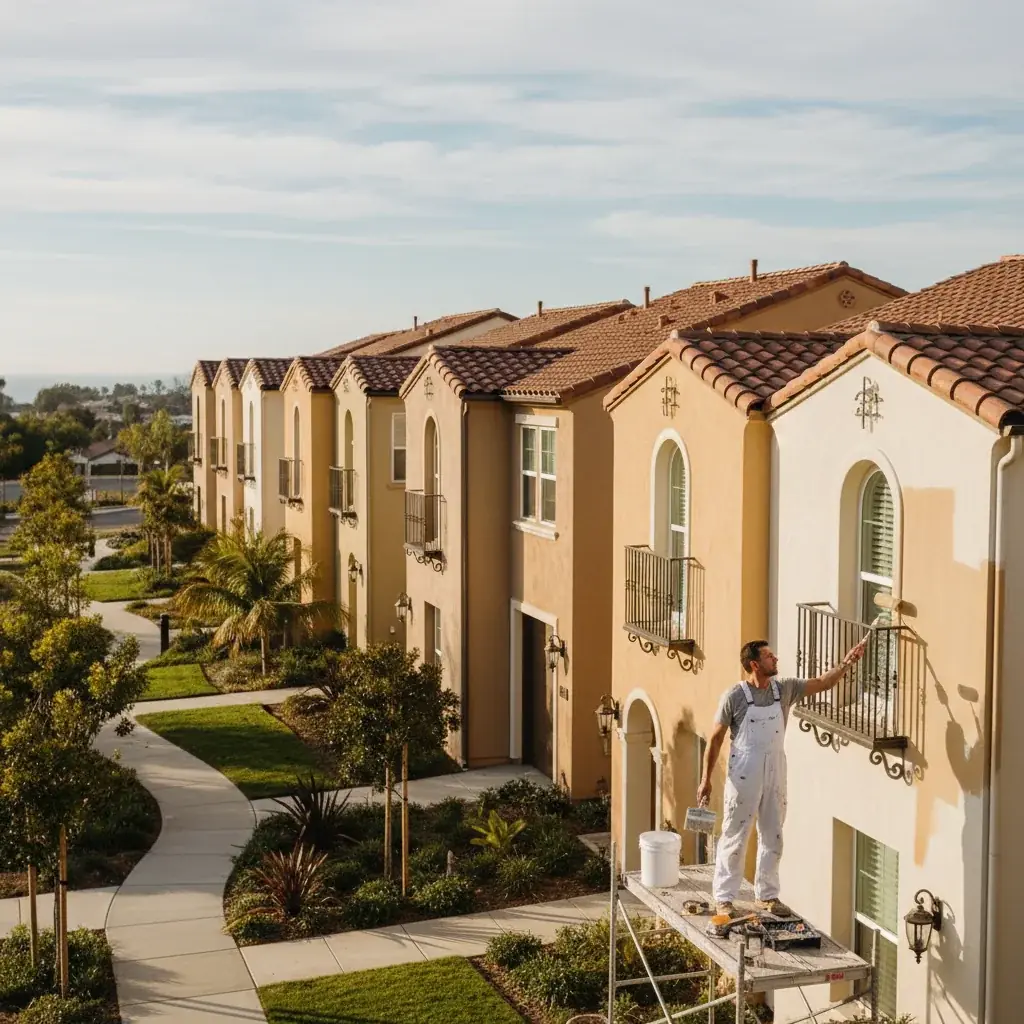
In San Diego HOA communities, exterior paint color approval works like this: you pick from your HOA’s pre-approved palette, submit an Architectural Review Committee (ARC) application with physical paint samples, and wait for the committee’s review. Committee approval takes time, so start the submission before you book the crew. The palette is usually limited to warm neutrals, soft grays, and muted earth tones that hold up in San Diego’s direct sunlight. Painting without approval first can result in a mandatory repaint at your expense. For project context beyond the HOA submission, see our residential painting guide for San Diego and the broader exterior painting guide for San Diego.
Why HOAs care about paint color (and what they actually enforce)
It can sometimes feel like HOAs create rules just for the sake of it, but their focus on exterior paint colors has a clear purpose: maintaining a consistent, harmonious aesthetic to protect property values for everyone in the community. They aren’t trying to stifle your personal expression entirely; they’re trying to prevent a hot pink house from popping up next to a lime green one. A cohesive look is a major selling point in many planned communities.
In places like Rancho Bernardo and Carmel Valley, the unified appearance is a key part of the neighborhood’s identity. Your HOA’s architectural committee is tasked with upholding that standard. They typically enforce rules on a few key elements:
- Body Color: The main color of your home’s siding or stucco.
- Trim Color: The color for eaves, window frames, fascia, and door frames.
- Accent Color: The color for your front door, shutters, or other decorative features.
- Sheen: The level of gloss in the paint. Most HOAs require a flat or satin finish for the body to reduce glare and specify a semi-gloss for trim and doors for durability.
The goal is to ensure every home complements its neighbors, creating a polished look that benefits the entire community. Sticking to the established HOA exterior color rules is the first step toward a smooth painting project.
Common approved palette types in San Diego HOAs
While every HOA has its own specific guidelines, we see consistent trends across San Diego County. The sunny, coastal environment heavily influences the most common HOA-approved paint colors. These palettes are designed to look good in our bright, direct sunlight without appearing washed out or overly intense.
You’ll rarely find pre-approved palettes with bold primary colors. Instead, expect to see schemes built around:
- Warm Beiges and Tans: These are the most common. Think colors like Swiss Coffee, Accessible Beige, or sandy tans that echo the local landscape. They are timeless and blend well with stucco and stone accents.
- Soft Grays and Greiges: A slightly more modern but still classic option. Light to medium grays with warm undertones (greiges) have become very popular in communities from 4S Ranch to Aviara in Carlsbad. They offer a contemporary feel while remaining neutral.
- Muted Earth Tones: Colors inspired by nature are almost always a safe bet. This includes soft sage greens, muted terracotta tones, and warm, earthy browns. These colors connect the homes to the surrounding canyons and natural open spaces common in San Diego.
- Off-Whites and Creams: Crisp but not sterile, off-whites provide a clean, classic look that works well with Spanish and Mediterranean-style architecture.
Many HOAs simplify the process by providing a book of pre-approved color schemes from specific manufacturers like Sherwin-Williams or Dunn-Edwards. If your HOA has one of these, your job is much easier. If not, sticking to these general color families is your best strategy. If you’re struggling to find the right shade, a professional color consultation can help you find the perfect, approvable hue.
What gets rejected most often, and why
Understanding why colors get rejected is just as important as knowing what gets approved. An HOA’s architectural review committee is looking for reasons to say no, and submitting a color that falls into a common “rejection” category is the fastest way to delay your project.
Here are the top reasons paint schemes are denied:
- Too Bold or Saturated: Bright yellows, deep blues, vibrant reds, or any color that could be described as “loud” will almost certainly be rejected. The goal is to blend in, not stand out.
- Too Dark: Many HOAs have rules against very dark colors like black, charcoal gray, or deep navy for the body of a home. Dark colors absorb more heat (a concern in sunny San Diego) and can make a house look out of place.
- Too Similar to a Neighbor: To avoid a “cookie-cutter” look, some HOAs mandate that your color scheme cannot be identical to your immediate neighbors. You may need to walk the block to ensure your choice is unique enough.
- Wrong Sheen: Using a semi-gloss paint on the body of your house is a common mistake. The glare is disruptive and looks cheap. Stick to the specified sheens for body and trim.
- Unapproved Combinations: Even if you choose three approved colors, they might not be approved together. Many HOAs have designated combinations of body, trim, and accent colors.
Avoiding these pitfalls is key. When planning your exterior painting project, always start with the approved list and work from there. Don’t fall in love with a color before you’ve confirmed it’s a viable option.
How to read your CC&Rs before picking a color
Your HOA’s guiding document is the Covenants, Conditions & Restrictions (CC&Rs). This legally binding document contains all the rules for the community, including the all-important architectural guidelines. Before you even look at a paint swatch, you need to get a copy of the most recent version of your CC&Rs and any associated architectural standards.
Find the section typically titled “Architectural Control,” “Exterior Alterations,” or “Architectural Committee.” This is where you’ll find the specific HOA paint color rules. Look for these key details:
- Pre-Approved Color Palettes: The easiest scenario. The documents may list specific paint names and codes from a major brand. This is your HOA color palette.
- Color Submission Process: The rules will outline exactly how to submit your choices for approval.
- LRV Requirements: Some more sophisticated HOAs specify a Light Reflectance Value (LRV) range. LRV is a scale from 0 (black) to 100 (white) that measures how much light a color reflects. HOAs use this to prevent colors that are too dark or too bright.
- Timeline for Approval: The documents should state how long the committee has to review your application, so you know what to expect before you submit.
Reading legal documents can be tedious, but it’s a non-negotiable step. Missing a key detail in the CC&Rs is the most common reason homeowners have to go back to the drawing board. Understanding the entire HOA exterior paint approval process starts with this document.
Submitting paint samples: what to include
Once you’ve selected a few potential color schemes that align with your HOA’s rules, you need to prepare your submission package for the architectural committee. A sloppy or incomplete application will cause delays. A professional, well-organized submission shows you’ve done your homework and respect the process.
Your application should always include:
- The Official Application Form: Fill it out completely. Don’t leave any sections blank.
- Physical Paint Samples: Do not just write down the names of the colors. You must provide physical samples or “chips” for each color. Tape these securely to a sheet of paper.
- Clear Labels: Label each sample clearly with its intended use (Body, Trim, Accent/Door), the paint brand (e.g., Sherwin-Williams), the color name (e.g., Naval), and the color number (e.g., SW 6244).
- A “Drawdown” (If Required): Some HOAs want to see a larger sample. You can create a drawdown by painting a poster board or small piece of drywall with your chosen body and trim colors. This gives the committee a much better idea of how the colors will look at scale.
- A Plot Map: Include a simple map or photo showing your house and your immediate neighbors’ homes, sometimes with their colors noted, to prove your choice doesn’t clash or duplicate.
The goal is to give the committee everything they need to make a quick and easy decision. The more thorough you are, the faster your approval will come.
Working with a painter who knows HOA rules
You don’t have to navigate this process alone. Working with an experienced local painting contractor who frequently handles HOA painting projects in San Diego is a significant advantage. A contractor who knows HOA work brings more than brushes and ladders.
The painters we match for HOA projects typically:
- Know the palettes: Many are already familiar with the pre-approved color schemes in communities like 4S Ranch, La Costa, and Eastlake.
- Help with submissions: They prepare professional submission packages with clearly labeled, accurate samples that meet committee requirements.
- Spot likely rejections: An experienced contractor can flag color combinations that tend to get kicked back, saving you the wait for a re-review cycle.
- Guarantee the approved spec: They paint to the exact colors, brands, and sheens the board approved. A reputable painter should always be licensed; you can verify any California contractor’s license on the CSLB website.
Partnering with a contractor who knows San Diego HOA rules makes the difference between a smooth approval and three rounds of back-and-forth. See all painting services in San Diego available across the county.
Frequently asked questions
What colors do San Diego HOAs typically allow for exterior paint?
Most San Diego HOA-approved palettes stick to warm beiges and tans, soft grays and greiges, muted earth tones like sage green and terracotta, and off-whites. Bold primaries, very dark colors, and high-saturation hues are almost always rejected. Many HOAs tie their palette to a specific manufacturer like Sherwin-Williams or Dunn-Edwards, so check your CC&Rs for exact paint codes before buying samples.
How do I get an exterior paint color approved by my HOA?
Submit an ARC application to your HOA’s architectural committee with a completed application form, physical paint chip samples labeled by use (body, trim, accent), and the paint brand, color name, and color number for each. Some HOAs also want a larger drawdown sample and a plot map showing your neighbors’ colors. The more complete your package, the faster the decision.
How long does HOA paint color approval take in San Diego?
Your CC&Rs set the committee’s review window, so start the submission well before you plan to book the crew. A complete, well-organized application moves faster than one missing samples or labels. An incomplete submission restarts the clock.
Can my HOA make me repaint my house if I paint without approval?
Yes. Painting without prior HOA approval is a CC&R violation. The HOA can require you to repaint using an approved color scheme at your own cost, and may add fines for each day the violation continues. Always get written approval before your painter starts.
What happens if the color I want isn’t on the approved list?
You can submit a variance request along with your ARC application asking the committee to consider a color outside the standard palette. The committee has discretion to approve or deny it. If you go this route, submit a larger drawdown sample and a written explanation of why the color fits the community’s aesthetic.
Do San Diego HOAs regulate paint sheen, not just color?
Yes. Most HOA guidelines specify a flat or satin finish for the body of the home to cut glare, and semi-gloss for trim and doors. Using the wrong sheen is one of the most common reasons applications get rejected or trigger a correction request after the paint is already on the wall.
When to call us
Picking a paint color for your home should be exciting, not stressful. If you’re feeling stuck between your HOA’s rulebook and your personal taste, we can help. Our team has helped hundreds of San Diego homeowners find beautiful, approvable colors and navigate the submission process with ease.
Call us at (858) 400-6422 and we’ll connect you with a vetted local painter.