Oak doors on a 1980s Vista kitchen still hold dishes. They just look tired. Replacing the boxes is a remodel. Painting them is a finish job, and those two quotes should never look the same.
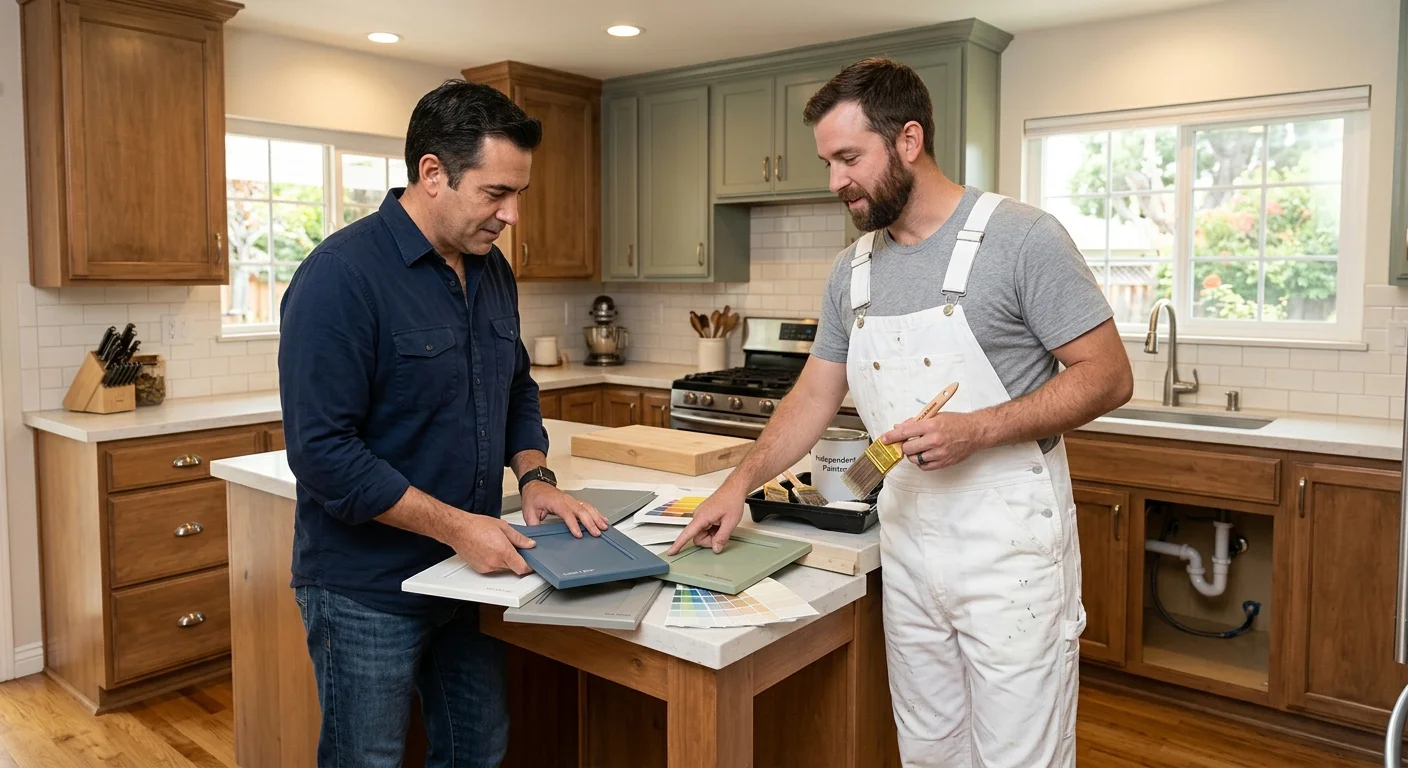
Paint Pros San Diego matches you with licensed, independent local painters. We do not paint cabinets, own a spray booth, or set a price. You contract and pay the painter directly. Use this page to scope a Vista kitchen or bath before you compare those written quotes.
Map the kitchen or bath cabinets in scope
Start with a door-and-drawer count, not a color name. Vista has 32,589 housing units, and the city’s largest build era is 1980 to 1989 (29.6% of units). About 34.6% of Vista units were built before 1978. That mix is why two houses a mile apart can need different prep.
Walk the kitchen first. Count uppers, lowers, and the island if you have one. Count drawer fronts as their own pieces. Note end panels, filler strips, toe kicks, and the inside of open shelves. Then walk the bath. Vanity doors, the medicine cabinet, and a linen tower are separate surfaces, even if they sit in a small room.
Write down what stays in the job. Some homeowners want every door and the boxes. Others want doors and drawer fronts only, and they leave the box interiors as they are. Those two scopes are not comparable. A painter who sprays doors off-site and only brushes the boxes is doing a different job than a painter who coats every interior shelf.
Vista sits inland in North County, along the SR-78 corridor, not on the beach. Cabinet painting in San Marcos faces a younger housing stock. San Marcos peaked in the 2000s, and only about 23.8% of its units predate 1978. Oceanside’s pre-1978 share is close to Vista’s (34.4%), but Oceanside sits on the coast. A Vista kitchen near downtown, South Santa Fe, or Palomar College is an inland cabinet job. Treat it that way.
Older Vista kitchens often mean factory oak, raised panels, and a finish that has seen years of cooking oil. Newer kitchens, including many in Shadowridge, may mean smoother doors, more MDF, or a factory paint film that chips at the edges. Do not guess the substrate from the curb. Open a door, look at the edge, and note whether you are looking at solid wood, veneer, MDF, or laminate.
If the house was built before 1978, paid work that disturbs paint can fall under the EPA Renovation, Repair and Painting program. About a third of Vista units sit in that age band. Testing is not required by the RRP Rule. Without documentation that the paint is not lead-based, the rule’s requirements stay in play for covered work. Ask the quoting painter how they handle pre-1978 homes. Confirm they will use a certified firm and a certified renovator when the rule applies.
A city permit for interior cabinet painting in Vista could not be confirmed from the sources on this site’s claims ledger. Unincorporated San Diego County exempts ordinary painting and papering from building permits. Vista is its own city. Check with the City of Vista before you assume the job is exempt, especially if the work is tied to a larger remodel.
Check doors, drawers, and damaged edges
The finish only looks as good as the edges. Run a finger along the door stile next to the dishwasher, the sink, and the trash pullout. Those are the first places a factory film fails. Look at the bottom of upper doors over the range. Heat and grease collect there. In a bath, look at the vanity doors beside the shower. Steam hits those edges every morning.
Separate cosmetic wear from structural failure. A worn topcoat on sound wood is a painting job. A delaminating door, a swollen MDF edge, or a box that has pulled off the wall is not. Soft particleboard at a sink base may need a carpenter before any primer goes on. If a door is already peeling in sheets, ask whether the painter will strip, repair, or tell you the door should be replaced.
Laminate and thermofoil are common on later Vista kitchens. They can take a cabinet coating when the film is still bonded. They fail when the film is already lifting. If you are not sure what you have, read whether laminate kitchen cabinets can be painted and have the painter say it in writing on the quote.
Mark every damaged corner on a simple sketch. Number the doors as they come off. That numbering is how a sprayed door set returns to the right opening. Missing numbers are how a 36-inch drawer front ends up on a 30-inch bay.
Hardware tells you part of the story. Original 1980s hinges and worn overlay doors often get reused. If you plan new pulls, decide that before the painter drills or fills. Filling old holes and drilling new ones is extra work. It should show up as a line item, not as a surprise on install day.
Bath cabinets pick up a different kind of damage than kitchens. Toothpaste, hair products, and standing moisture at the sink leave stains that a light sand will not hide. A stain-blocking primer such as Zinsser Cover Stain or Zinsser B-I-N is a spec example painters use on those marks. Naming the primer is a product fact. It is not a promise that every Vista job needs that product.
If the cabinets are sound, kitchen cabinet refinishing in Vista is usually cheaper than a full replacement. If the boxes are failing, painting them only hides the problem for a season. Be honest on the walkthrough. A good painter will tell you when the better spend is new doors, not a new film.
Compare preparation and finish options
Prep is the job. Color is the last coat. The professional cabinet refinishing process is a sequence: empty, label, degrease, repair, sand, prime, finish, then rehang. Skip a step and the film telegraphs every grease print and every raised grain.
Degreasing matters more in a Vista kitchen that has been cooked in for decades than in a rarely used guest bath. A painter should say how they clean: what product, whether they rinse, and whether they scuff-sand after the surface dries. “We’ll sand and paint” is not a prep plan.
Then compare how the finish goes on. Three common methods show up in San Diego quotes.
Brush-and-roll in place leaves the doors on the boxes. It is the least disruptive method. It also leaves more brush texture. Doors sprayed and boxes brushed is the middle path: doors leave the kitchen, boxes stay, and the painter coats the frames in the house. Full spray, doors and boxes, is the highest-control method when the painter can contain the room or take the doors to a booth.
None of those methods is “the Vista method.” A small galley off Civic Center Drive may not have room to stage 30 doors. A larger Shadowridge kitchen might. The access is part of the spec.
For the coating itself, ask for a cabinet-rated enamel by name. Spec examples on the current market include Sherwin-Williams Emerald Urethane Trim Enamel, Sherwin-Williams ProClassic, Benjamin Moore ADVANCE, INSL-X Cabinet Coat, and PPG Break-Through. Those names are publishable as product examples. Do not attach a lifespan, a warranty term, or a dollar figure to any of them. The painter chooses the system. You choose whether the quote names it.
Sheen is a separate choice. Kitchen cabinets take more hand oil than a hall door. A satin or semi-gloss enamel is the usual ask. A dead-flat wall paint is the wrong product, even if the color matches. If you also want the walls done, that is interior house painting, not the cabinet spec. Keep the two quotes apart so you can see what you are paying for.
When the home is pre-1978 and the work disturbs paint, federal RRP work practices apply to covered firms. That means a certified firm and a certified renovator, signs at the work area, containment so dust does not leave the room, and HEPA on any sander used on painted surfaces. Heat guns, if used, stay under 1,100°F. Those are rule requirements for the firm, not a brand promise from Paint Pros San Diego.
Do not accept a verbal “we spray everything.” Ask whether doors are coated off-site, how many finish coats are in the price, and whether the painter primes bare wood, factory film, or both. A quote that skips primer on stained oak is a different product than a quote that primes every face.
For a wider look at cabinet painting and refinishing across the county, use the service page to see what the matched painters actually bid. Then bring that checklist back to your Vista kitchen.
Review hardware, access, and exclusions
A clean cabinet quote is as much about what is out as what is in. Read the exclusions before you compare totals.
Hardware is the first split. Some painters remove, bag, and reinstall your existing hinges and pulls. Some ask you to supply new hardware and they install it. Some paint around the hinges and never take the doors off. That last method is faster. It also leaves unpainted rings if you later change the hinges. Get the method in writing.
Access is the second split. Vista lots are not all one-story ranch plans. A split-level kitchen, a tight galley, or a house with one interior stair changes how doors move in and out. Ask where the painter will stage doors, how they protect counters and floors, and whether you need to empty every cabinet before they arrive. If you live in the house, ask whether the kitchen stays usable and which days it will not.
Exclusions hide in the last paragraph. Common ones: interiors of boxes, the insides of drawers, glass inserts, appliance panels, crown molding, new doors, new boxes, plumbing disconnects, electrical under-cabinet lights, and caulk against a stone backsplash. If you want the crown and the light rail coated, say so. If you do not, make sure you are not paying for them on one quote and skipping them on another.
Bath work has its own exclusions. A painter is not a plumber. A vanity that has to pull off the wall for a leak is a different trade. Mirror clips, medicine-cabinet interiors, and cultured-marble tops are easy to assume are “part of the cabinets.” They usually are not.
Occupied homes need a protection plan, not a vibe. Plastic on the counters, taped vents, and a path from the door to the staging area are part of the job. So is a rule about pets and kids in the work room. None of that is a schedule promise. It is how the painter keeps overspray off the rest of the house.
If you already have a Vista painting contractor in mind for walls or exterior stucco, do not assume that person is the cabinet painter. Cabinet enamel, spray setup, and door logging are a different skill than rolling a living room. It is fair to ask whether the same independent pro does both, or whether you want a painter who focuses on cabinets.
Compare written quotes before you hire
Price without scope is noise. Two Vista kitchens with the same door count can land in different bands because of islands, damage, and spray versus brush.
Paint Pros San Diego sets no prices. The figures below are named, dated planning ranges from other San Diego publishers. They are not a quote from this site, and they are not a Vista-only survey.
Chism Brothers, in a post updated March 2, 2026, published these planning ranges for a standard kitchen: brush-and-roll in place about $1,800 to $2,500; doors sprayed and boxes brushed about $3,000 to $5,000; full spray about $5,000 to $7,500; a large island kitchen $8,500 to $15,000-plus.
J Brown Painting has published about $4,500 to $6,250 for a small-to-standard kitchen, and $6,250 to $9,000 for a large kitchen with 40-plus doors.
Use those bands to sanity-check a number, then read what the number buys. A $3,200 quote that skips box interiors is not cheaper than a $4,800 quote that includes them. Line up door count, method, primer, coat count, hardware, and exclusions in a table. Then look at the total.
For a countywide walkthrough of those same ranges, see cabinet painting cost in San Diego. Vista is one inland city inside that market. It is not a separate price list.
Licensing is not optional on a job at or above California’s minor-work threshold. As of 2026, Business and Professions Code §7048 sets that threshold at $1,000 for the aggregate contract price, labor and materials together. A kitchen cabinet job sits above that line. Ask for the painter’s CSLB number and check it on the CSLB site before you sign. A C-33 Painting and Decorating classification covers surface preparation and the application of paints, varnishes, shellacs, stains, and similar coatings. Unlicensed advertising of work that requires a license is a misdemeanor under B&P §7027.1.
If the painter solicits and you sign at your house, California Civil Code §1689.7 gives you until midnight of the third business day to cancel (the fifth business day if you are a senior). The contract should include that notice in the same language as the sales talk. That is a home-solicitation right. It is not a warranty on the paint film.
Ask each painter the same four questions. How many doors and drawer fronts are in the price. Where the doors get coated. What primer and finish products they will use. What happens if an edge chips during the first season, in that painter’s own written warranty, not in a promise from this referral service. We do not warrant the work. The painter you hire does, on their terms.
Color is the easy part, and it still deserves a sample door. Pull chips from the Sherwin-Williams color collections or Benjamin Moore color trends, then have the painter coat one door in the actual enamel. North County inland light is brighter than a store booth. White that looks clean at noon on a Vista counter can read blue after dinner.
When the scopes match, pick the painter, not the lowest number. Then sign a contract that names the rooms, the method, the products, and the exclusions.
When to call us
Call when the boxes are sound, the doors are worn, and you want a licensed local painter to refinish a Vista kitchen or bath instead of replacing it. Call us at (858) 400-6422 and we’ll connect you with a licensed local painter. You contract with that painter directly, and you confirm license, scope, and warranty with them before any door comes off.