Most Alpine cabinet searches mix three jobs: paint the doors you have, reface with new doors and veneer, or replace the boxes. Those are not the same scope, and they do not fail in the same places. On a 1990s kitchen off Alpine Boulevard or Tavern Road, the boxes decide the path before anyone talks color.
Paint Pros San Diego is a referral service. We match you with licensed, independent painters. We do not refinish cabinets, own a shop, or set a painter’s price. The cabinet painting page is the service path for coating work. True refacing (new doors, new veneer on old boxes) is a different trade mix. Get that split on paper before you hire.
Map the kitchen or bath cabinets in scope
Walk the room with a notepad, not a Pinterest board. Count every door, drawer front, and false panel you can see from a standing view. Include the island, the desk, the pantry, glass uppers, and the range hood panel if it matches. Bath vanities and a laundry stack count if you want them in the same finish. A quote that skips the island or the microwave cabinet is not a kitchen quote.
Alpine is unincorporated East County, along the I-8 corridor, not a coastal tract and not Harbison Canyon. Census figures for the Alpine place show 5,641 housing units. The largest build share is 1990 to 1999 at 30.6 percent. About 31.6 percent of units predate 1978. That mix matters. Many kitchens here are builder oak, raised-panel doors, or laminate from those 1990s years. Older stock still shows up on larger lots toward Willows Road and the foothills. Harbison Canyon’s housing peaked in the 1970s. Santee is an incorporated city with more tract repetition. Do not copy a canyon or Santee scope onto an Alpine set.
Mark sun and soil. Inland light through west and south glass heats door faces in the afternoon. Cooking grease collects on uppers by the range. Dry East County dust sticks to that film. Those doors need a different prep conversation than a powder-room vanity that only sees hand soap.
Open every box. Look at the interior color, the shelf pins, and whether the carcass is plywood, particleboard, or a mix. Refacing keeps those interiors. So does painting. Replacement is the only path that changes box layout, depth, or a dead corner. If you want a different footprint, stop calling it alpine cabinet refacing. That is a remodel.
Write exclusions while you walk. Toe kicks, light rail, crown, open shelves, matching new end panels, and the inside of drawers are easy to assume and easy to omit. If a bathroom vanity is in play, note the sink top, the caulk line, and whether the doors clear the faucet. The painter you hire can only price what you put on the list.
Check doors, drawers, and damaged edges
Pull a door off one hinge and look at the edge, not the center panel. Chips, swollen particleboard, and peeling veneer show up first at the corners and around pulls. Water damage lives under the sink, beside the dishwasher, and on the tray by the coffee maker. If the box edge is soft, no new door style hides it for long.
Name the substrate out loud. Solid wood and factory-finished oak take coating work differently than thermofoil, melamine, or laminate. A painter can often refinish sound wood doors in place or in a shop. Laminate and thermofoil need an adhesion test, not a guess. If the plastic film is already lifting, painting over it is a bet. Refacing those doors (new doors on the old boxes) may be the honest move. Replacement is the move when the boxes themselves have swollen or racked.
Refacing has real downsides. You keep the old layout, the old interiors, and any out-of-square boxes. Veneer on the face frames has seams. If a box is water-damaged, a pretty door still hangs on a failing carcass. You also mix trades: someone makes or orders doors, someone wraps or paints the frames, someone hangs hardware. That is more coordination than a coating-only job. It is still less disruption than a full tear-out, which is why people search it. It is not a free upgrade.
Resurfacing (painting or clear-coating the doors you have) is a good idea when the boxes are square, the edges are sound, and you like the layout. It is a poor idea when doors are delaminating, when you want inset instead of overlay, or when you need more storage, not a new color. How long a refinished or refaced kitchen lasts is not a figure we can publish. No verified service-life number for Alpine or San Diego County sits in our claims record. Ask the quoting painter what they put in writing on their own work. Paint Pros San Diego does not warrant the finish.
On pre-1978 houses, paid work that disturbs paint can fall under the EPA Renovation, Repair and Painting rule. Alpine’s pre-1978 share is 31.6 percent, lower than many older East County pockets and still high enough to check the build year. Testing is not required by that rule. Without documentation that the paint is not lead-based, the rule’s requirements stay in play for covered jobs. Ask whether the firm is EPA-certified when the house is old enough.
Compare preparation and finish options
Prep is the job. Finish is what you see in photos. A professional cabinet refinishing process starts with emptying, labeling, degreasing, and a repair pass on chips and hinge holes. Alpine kitchens collect cooking film and inland dust. If that film stays, the coating fails at the handle and the door edge first.
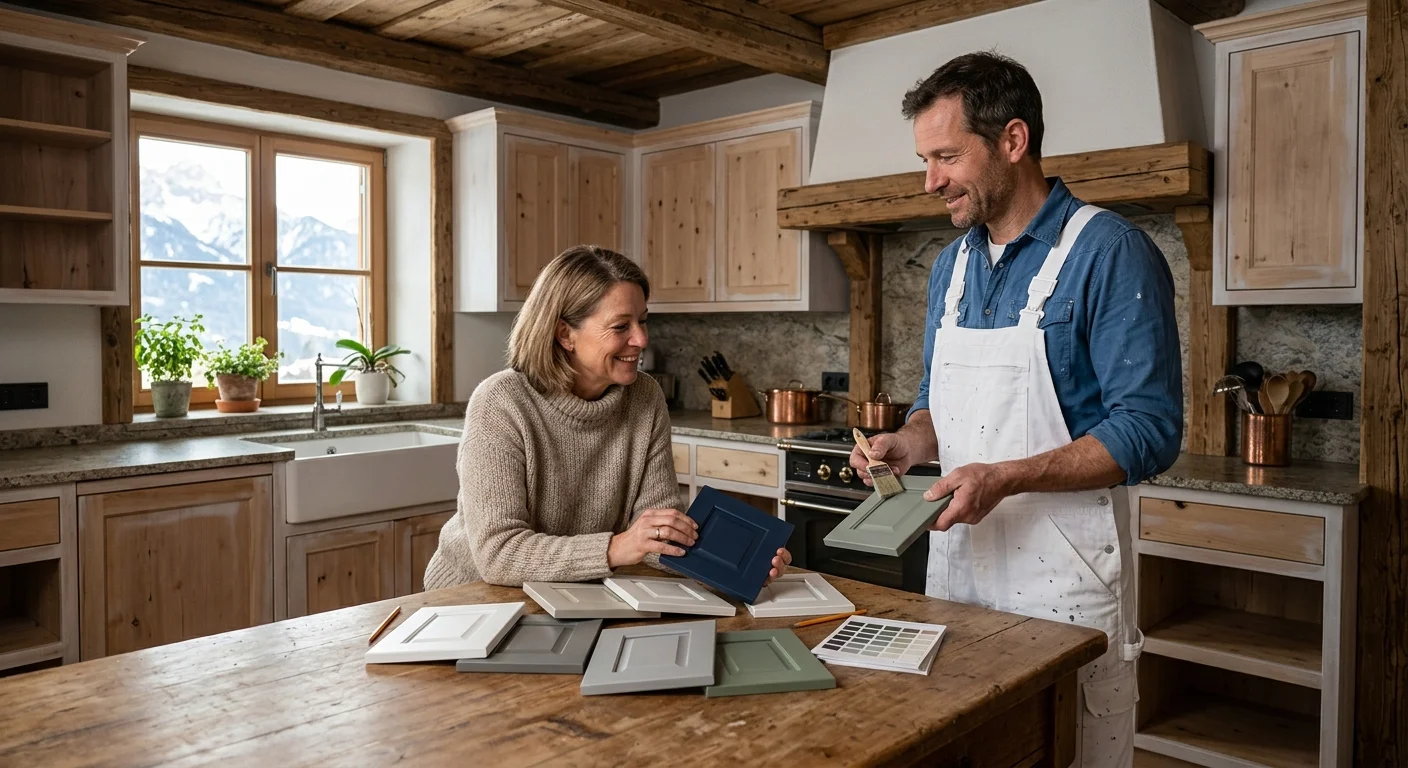
Ask how doors come off, where they get sprayed, and what happens to the boxes in the room. Brush-and-roll on boxes with sprayed doors is a common split. Full spray is another. Those methods are not interchangeable on a quote. For stain blocking on woods that bleed, painters often reach for primers such as Zinsser Cover Stain or Zinsser B-I-N. For the finish coat, spec examples on the market include INSL-X Cabinet Coat, PPG BREAK-THROUGH, Sherwin-Williams Emerald Urethane Trim Enamel, and Benjamin Moore ADVANCE or Scuff-X. Those names are product examples, not a promise about this brand and not a lifespan claim. Do not attach a year count to any of them.
If the painter will sand, ask about dust control. On painted pre-1978 surfaces, federal work-practice rules require a HEPA vacuum attachment on sanders and grinders, or those tools are not allowed on the paint. Heat guns, if used, stay under 1,100°F. Containment so dust does not leave the work area is part of that same rule set. Even on a 1990s kitchen with no lead issue, you still want doors labeled, rooms protected, and a plan for pets and a working sink.
Color is the fun part, and it still needs a sample on your actual door, in your actual light. Sherwin-Williams color collections and Benjamin Moore color trends are starting points. Alpine afternoon sun is harsher than a coastal kitchen. A white that looks clean at 9 a.m. can read hot by 3 p.m. on an island that faces glass. Have the painter leave a sample door through a full day.
Painting and similar finish work are exempt from building permits in unincorporated San Diego County. Alpine sits in that unincorporated area. That exemption is for finish work. It does not automatically cover a full cabinet replacement, a layout change, or electrical and plumbing moves. If the job leaves the world of coating and hanging doors, ask the County Planning & Development Services desk what they want to see.
Review hardware, access, and exclusions
Hardware is where cheap quotes hide. New pulls often need new hole patterns. Overlay doors and inset doors do not use the same hinges. Soft-close hardware is a product choice, not a default. If you keep existing holes, say so. If you want a different pull size, the painter or the millwork shop has to fill and redrill. Put that in the scope.
Access on Alpine lots is not a condo hallway. Kitchens here often sit in larger homes, sometimes with a long driveway, ranch dogs, and a family still cooking. Ask where doors will be staged, whether the shop is on-site or off-site, and which rooms stay closed. Do not expect a live-answer promise from our phone line. We connect you with a painter. That painter sets the work window with you.
Exclusions should be ugly and specific. Interiors of boxes painted or not. Shelves. Drawer boxes versus drawer fronts. Matching a new island to old runs. Appliance panels. Glass inserts. Crown that returns into a soffit. Caulk at the counter. Touch-up kit. Hardware supply versus hardware install. If a line is missing, assume it is not in the price.
License class follows the work. A C-33 painting contractor’s classification covers surface preparation and the application of paints, stains, varnishes, and similar coatings. Ordering and hanging new doors can sit in a different classification. Ask which license covers the exact scope on your quote. Then verify it on the CSLB license check before you sign. Under current California law, projects at or above $1,000 (labor, materials, and other items combined, as of 2026) require a licensed contractor.
If the contract is signed at your house, California’s home-solicitation rule gives you until midnight of the third business day to cancel (fifth if you are a senior). The notice has to be in the contract. Read that page before you put a deposit on custom doors you cannot return.
Compare written quotes before you hire
Get the same map on every bid: door count, drawer count, boxes in or out, sprayed or brushed, primer and finish named, hardware, lead-safe language if the house is pre-1978, and what is excluded. A low number that paints doors only will lose to a complete number that includes boxes, caulk, and hardware fill. Compare scopes, then money.
Paint Pros San Diego does not publish a brand price for Alpine cabinet refacing or kitchen cabinet painting Alpine work. Independent San Diego painters do publish planning ranges for cabinet painting, not for refacing. Chism Brothers (updated March 2, 2026) cites about $1,800 to $2,500 for brush-and-roll in place on a standard kitchen, about $3,000 to $5,000 when doors are sprayed and boxes are brushed, about $5,000 to $7,500 for a full spray, and $8,500 to $15,000-plus for a large island kitchen. J Brown Painting cites about $4,500 to $6,250 for a small-to-standard kitchen and $6,250 to $9,000 for a large kitchen with 40-plus doors. Those are their figures, dated as above. They are not our quote, and they are not a refacing catalog.
Is refacing cheaper than replacement. Often it costs less than new boxes, new counters, and a layout change, because you keep the carcasses. No verified “half the price” rule turned up in our claims record. Replacement also absorbs demo, possible plumbing, and a longer kitchen shutdown. Ask each bidder for an itemized page, not a single lump.
Our Alpine painting contractor guide covers how to hire in this community. For cabinets, add three checks: a labeled door count, a named coating or door product, and a written statement of who owns warranty on the finish. We do not give that warranty. The independent pro does, if they offer one.
If two quotes diverge, it is usually doors in a shop versus doors on the hinges, or new doors versus old doors recoated. Make them say which job they are selling. Then hire the one whose scope matches the kitchen you walked with a notepad.
When to call us
Call when the boxes are worth keeping and you want a licensed painter to refinish doors, or when you need help telling coating work apart from a true reface. Call us at (858) 400-6422 and we’ll connect you with a licensed local painter. There is no connection fee from our side. You contract and pay the pro directly.