TL;DR
- 2026 is moving away from stark white and cool gray toward warm neutrals, soft greiges, and muted sage.
- San Diego’s light is warm and golden, warm undertones hold up; cool-gray whites can read blue or institutional.
- Coastal light is slightly cooler (more blue) than inland; inland can push warmer colors too far into yellow.
- Always sample colors in large format (12x12”) on your actual wall in your actual light before committing.
- These ten colors are the ones showing up on the most San Diego walls right now.
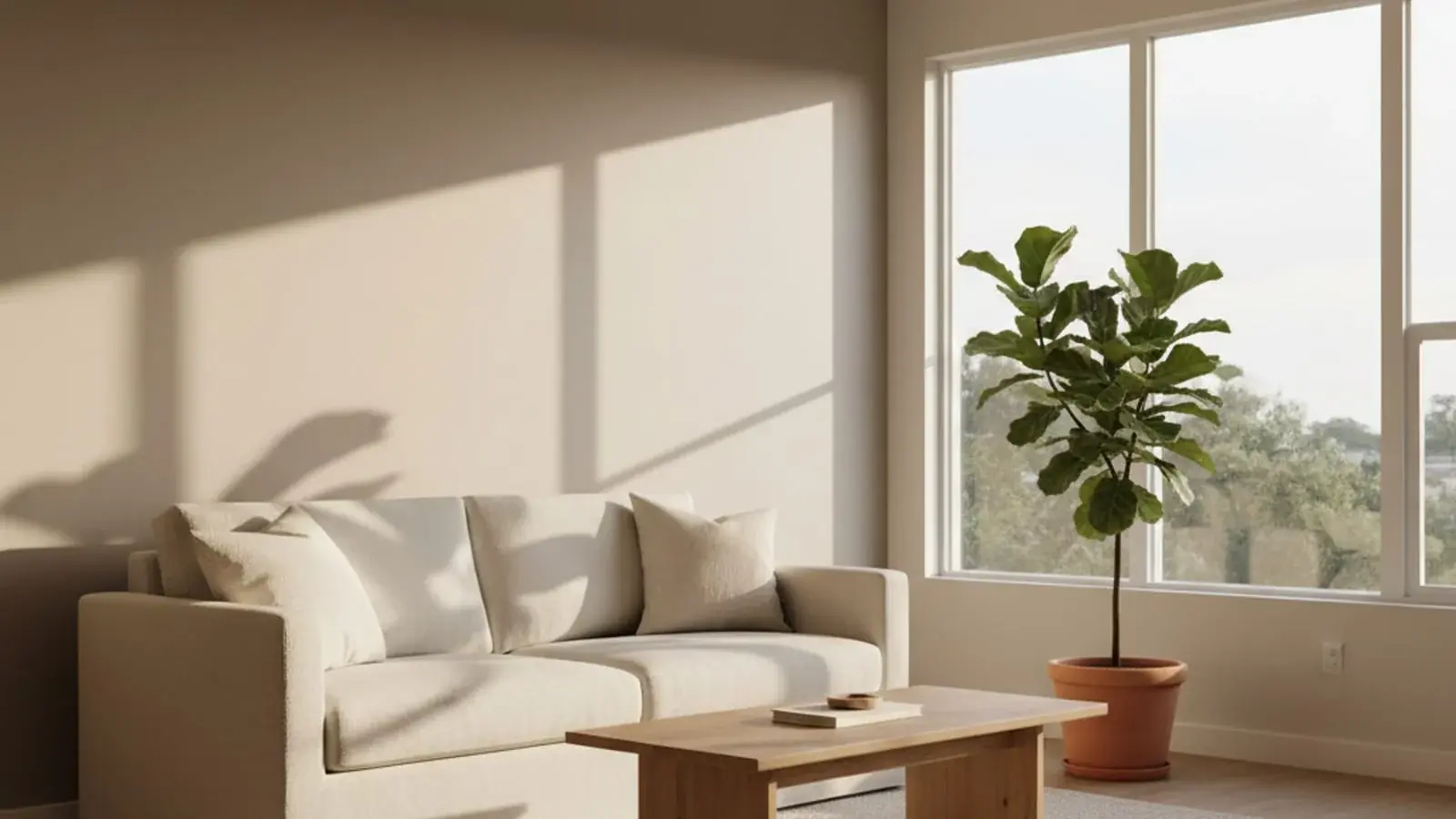
The top interior paint colors for San Diego homes in 2026 are warm whites (SW Alabaster, BM White Dove), soft greiges (SW Accessible Beige, SW Aesthetic White), and muted sages (BM Saybrook Sage, SW Evergreen Fog). San Diego’s warm, bright natural light makes cool grays read cold or institutional. These ten colors hold up across coastal and inland SD County homes because their warm undertones work with the local light rather than against it.
Why does San Diego light matter for paint color?
Paint colors don’t behave the same under every light. What looks warm and inviting in a showroom under fluorescent light often looks completely different on your wall at 4pm on a San Diego afternoon.
San Diego’s natural light has two distinct characteristics:
- It’s warm. The sun’s color temperature skews golden, especially at sunrise and sunset, but even at midday the light is warmer than in the Pacific Northwest or the Northeast. Colors with cool undertones (blue, gray, purple) can read institutional or cold.
- It’s bright. San Diego gets more sunny days per year than almost any US metro. Colors that look deep and saturated in a dim room look washed out in full San Diego sun. Conversely, colors that look too pale in a store look perfect on a sun-lit wall.
There’s also a coastal-inland split: homes in Encinitas, La Jolla, and Oceanside get slightly cooler light (marine layer diffuses and cools mornings) than homes in El Cajon, Escondido, or Ramona. Same color can read differently just 15 miles apart.
Warm white: the new “white” for 2026
Pure white (SW Extra White, BM Super White) is being replaced by warm whites for interior walls:
- SW Alabaster (SW 7008). The Sherwin-Williams 2016 Color of the Year that never actually went out of style. Warm cream undertone, reads clean but not cold. Works in any light.
- BM White Dove (OC-17). The Benjamin Moore warm white. Softer than pure white, reads as “white” to most eyes but has just enough cream in it to avoid feeling clinical.
- SW Pure White (SW 7005). Slightly whiter than Alabaster but still has a gentle warm undertone. Good for San Diego homes where you want white walls without the cold snap.
Pure cool whites can still work in small doses, accent trim against a warmer wall color, for instance, but for whole-room walls in San Diego homes, warm whites age better.
Soft greige: the everyday neutral
Greige is the middle ground between gray and beige. Done right, it’s the color you don’t think about, it just looks clean and feels easy in any light.
- SW Accessible Beige (SW 7036). A classic. Warmer than greige, leans slightly into beige territory. Works great in north-facing rooms that need warming up.
- BM Classic Gray (OC-23). Misleadingly named, it’s actually a warm off-white-greige hybrid. Very neutral, flexible, and ages well.
- SW Aesthetic White (SW 7035). Warm greige with a creamy cast. Popular in 2026 as a replacement for both Accessible Beige and Agreeable Gray at once.
Muted sage: the bold-but-safe color
Sage green has been “the” accent color for three years running and shows no sign of slowing down. The 2026 version is quieter than the 2023 peak, muted, dusty, almost herbal:
- BM Saybrook Sage (HC-114). A classic New England sage, subtle, soft, goes with warm wood floors.
- SW Evergreen Fog (SW 9130). A muted sage-teal hybrid. Warmer than Saybrook Sage, more versatile.
- BM Sherwood Green (HC-118). Deeper and more saturated. Works as an accent wall or full dining room in homes with good natural light.
Sage greens work especially well in San Diego homes because they echo the outdoor palette, succulents, sage, eucalyptus, ocean grass. Rather than fighting the landscape, they tie to it.
Soft terracotta and dusty rose
A quieter return of warm earth tones in 2026:
- BM Smoked Oyster (2109-40). A pinkish-warm neutral. Reads as “sophisticated off-white” rather than pink.
- SW Redend Point (SW 9081). SW’s 2023 Color of the Year. Terracotta-adjacent, warm, grounding. Better as a dining room or bedroom accent than a full-house wall color.
These are best for specific rooms, bedrooms, dining rooms, powder rooms, not whole-house applications.
What about trim and ceilings?
Trim and ceiling color direction for 2026:
- Trim: warm white in semi-gloss or satin. Match the wall color’s undertone so it reads as one palette. SW Alabaster on walls pairs with SW Pure White on trim; BM Classic Gray walls work with BM Simply White (OC-117) trim.
- Ceilings: the same warm white as trim or slightly lighter. Pure white ceilings read as cold against warm walls. Matching or closely related tones unify the room.
- Doors: contrast. Interior doors in a deeper tone (soft charcoal, deep sage, warm black) against lighter walls are a 2026-forward choice.
How to pick a color without regretting it
Three rules that matter for every color choice:
1. Test in large format, on the actual wall
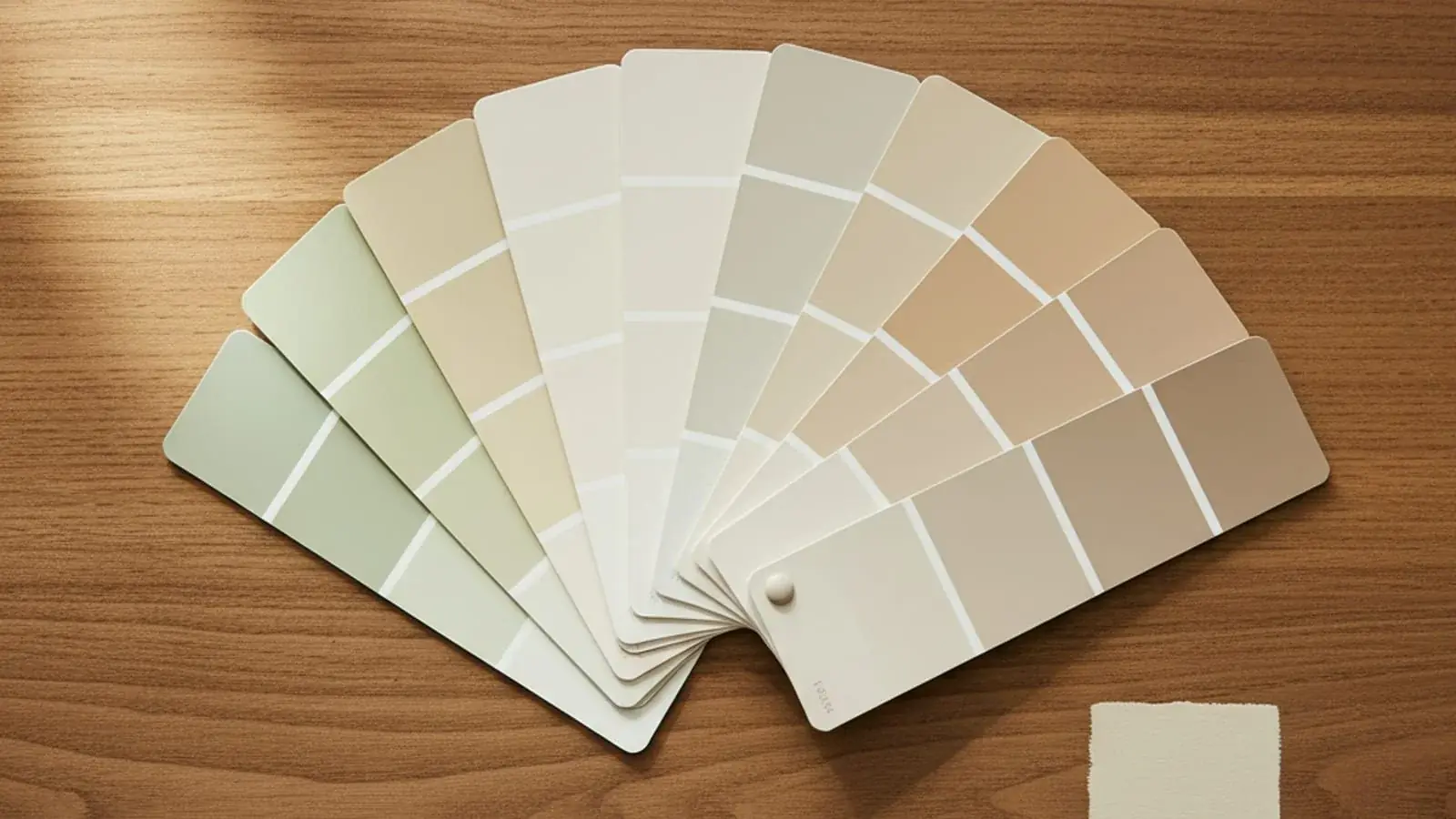
A 1x1” swatch card under store lighting tells you nothing about how the color will look on your wall. Get a quart of the top two or three candidates, paint a 12x12” square directly on the wall (or on a big piece of foam board), and look at it at 7am, 12pm, 5pm, and after dark.
2. Test on multiple walls
Light hits different walls differently, north walls are cool, south walls are warm, east walls are bright in the morning, west walls are bright in the afternoon. A color that looks perfect on your accent wall might look wrong on the perpendicular wall. Sample both.
3. Pick the undertone that matches your fixed elements
Your flooring, your cabinets, your countertops, your stone fireplace, those aren’t changing with the paint. Pick a wall color whose undertone (the secondary color subtly present in the paint) matches or complements your fixed elements. A greige with warm undertones pairs with warm wood floors. A greige with cool undertones pairs with gray or white tile.
The 2026 “avoid” list
A few colors to steer clear of in 2026:
- Cool grays. The Agreeable Gray / Repose Gray / Stonington Gray era is done. They’re not ugly, they’re just dated.
- All-white interiors. Pure white walls + white trim + white ceiling + white sofa reads as institutional or builder-grade in 2026. Warmth wins.
- Saturated accent walls. Navy, deep emerald, wine red, the big saturated accent wall trend of 2019–2021 is fading. Muted accents (sage, dusty rose, warm clay) are replacing it.
- Beige-beige. The 2005-era flat beige everywhere is different from warm greige. Old builder beige reads dated. Warm greige reads current.
What about an HOA community?
If you’re in an HOA community with exterior color restrictions (most San Diego master-planned communities), your interior colors are your own. Exterior is where HOA rules apply.
For interiors, the 2026 color choices work just as well in a Fairbanks Ranch estate as they do in an Otay Ranch tract home. The constraint is light and layout, not the HOA.
Frequently asked questions
What are the most popular interior paint colors in San Diego in 2026?
Warm whites, soft greiges, and muted sages are the top choices on San Diego walls in 2026. Specific colors leading the shift are SW Alabaster, BM White Dove, SW Accessible Beige, SW Aesthetic White, BM Saybrook Sage, and SW Evergreen Fog. The move is away from cool grays toward colors with warm undertones that work with San Diego’s golden natural light.
Why do cool-gray paint colors look wrong in San Diego homes?
San Diego’s sunlight skews warm and bright, and cool-gray paints have blue or purple undertones that fight that light. On a San Diego wall at midday or late afternoon, colors like Repose Gray or Stonington Gray can read cold, blue, or institutional rather than clean and neutral. Warm undertones hold up; cool undertones don’t.
How do I choose an interior paint color for my San Diego home?
Sample two or three finalists as large-format patches (at least 12x12”) painted directly on your wall or on foam board. Look at each sample at different times of day: morning, midday, late afternoon, and after dark. Pick the color whose undertone matches your fixed elements (flooring, cabinets, countertops), since those aren’t changing with the paint.
Is coastal San Diego light different from inland when choosing paint colors?
Yes. Homes in Encinitas, La Jolla, and Oceanside get slightly cooler morning light because the marine layer diffuses it. Homes in El Cajon, Escondido, and Ramona get warmer, more direct light. The same paint color can read differently just 15 miles apart. Coastal homes have a little more flexibility with cooler-leaning neutrals; inland homes should lean warmer.
Is a professional color consultation worth it before painting?
A color consultation catches undertone mismatches before you’ve bought five gallons and painted two rooms the wrong color. Ask about an in-home color consultation when you call, the cost is often credited toward the project if you move forward with a painter in our network.
What trim and ceiling colors work with warm neutrals in 2026?
Match the undertone of the wall. SW Alabaster walls pair with SW Pure White on trim. BM Classic Gray walls work with BM Simply White (OC-117) on trim. Avoid pure cool white ceilings against warm walls, they create a visible temperature clash. Interior doors in a deeper tone, soft charcoal, deep sage, or warm black, against lighter walls are the current forward choice.
Ready to pick colors?
Color is the hardest decision in any paint project, and the easiest one to get wrong. Ask about an in-home color consultation with large-format samples, the cost is often credited toward the project if you book interior painting with a painter in our network.
Or give us a call at (858) 400-6422 and we’ll connect you with a painter who can bring fan decks to your request a painter. Want the bigger picture before you pick a color? Our complete interior painting guide for San Diego and the step-by-step interior painting process cover everything from prep to the final coat.